File info
Every file type has an Info view, reachable via:
iin the viewer — jump straight thereTab— cycle into Info as one of the file's view modes--infoon the CLI — print info and exit
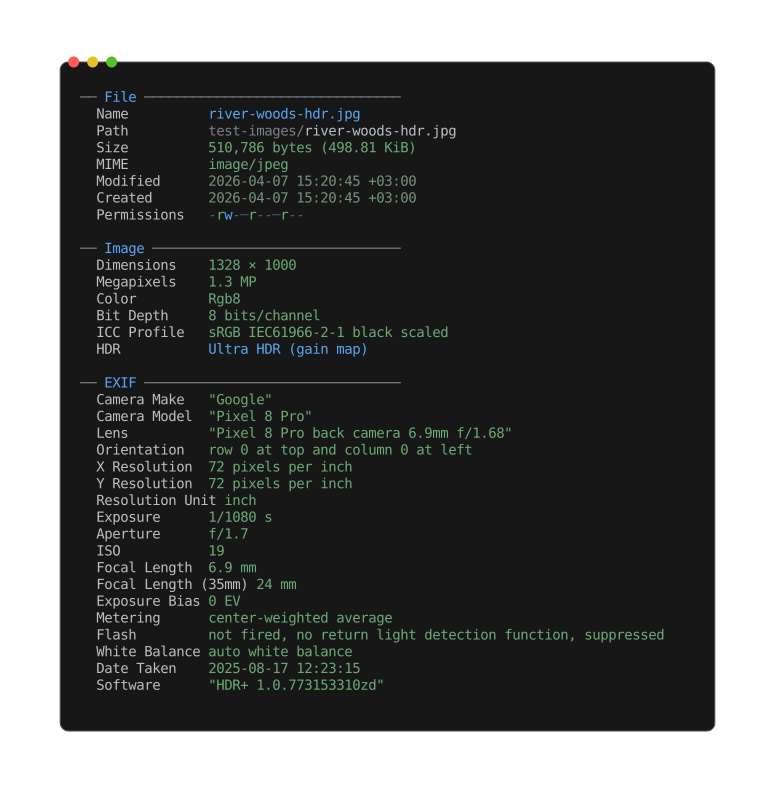
The Info view groups universal fields (name, size, MIME, timestamps) with format-specific sections — here the image's dimensions, color model, HDR gain map, and the camera / lens / exposure metadata read straight from EXIF.
Universal fields
- File — name, path, size (exact + human-readable)
- MIME — detected via magic bytes
- Permissions — per-character coloring
- Timestamps — created / modified / accessed, age-based coloring
Format-specific sections
| File kind | Info section adds |
|---|---|
| Text / source | Line / word / char counts, blank lines, longest line, line endings, indent style, encoding, shebang |
| Markdown | Heading counts, fenced code + langs, links, images, tables, list items, task progress, reading time |
| SQL | Dialect, statement counts by category, created-object inventory, comment count, PL/pgSQL flag |
| CSS | Rule count, selector count + per-kind histogram, @media / @keyframes / custom-property counts, @import list, colour swatch grid |
| Structured data | Top-level kind, key/element count, max nesting depth, total node count |
| CSV / TSV | Format, delimiter, encoding, header detection, per-column type inference, record count, malformed-row counter |
| Spreadsheet | Sheet count + names, title, author, subject, keywords, created / modified |
| SQLite | Page size, page count, encoding, journal mode, schema / user version, table / view / index / trigger counts, total rows, largest tables |
| XML / SVG | Root element, namespaces, element counts |
| Notebook | Format, kernel, language, cell counts (code / markdown / raw), output / image / error counts, max execution count |
| Image | Dimensions, megapixels, color mode, bit depth, ICC profile, HDR, EXIF, XMP |
| Animation | Frame count, total duration, average FPS, loop count |
| Audio | Container, codec, channels, sample rate, bit depth, bitrate, duration; tag fields |
| Document | Title, author, subject, keywords, dates, paragraph / word / image counts |
| Message count, From, To, Cc, Subject, Date, Message-ID, attachment count | |
| Calendar / contacts | iCalendar: name, event / todo counts, date range, version, product. vCard: contact count, version |
| PDF version, metadata, page count, attachment count, inline-image count | |
| EPUB | Dublin Core metadata, spine length |
| EPS / PostScript | Title, creator, created, BoundingBox, language level, page count, preview, render |
| Comic | Page count, total image bytes |
| Archive | Entry / file / directory counts, total uncompressed size |
| Directory | Entry / file / subdirectory counts |
| ISO | Volume label, system ID, publisher, application, four PVD timestamps |
| DMG | UDIF version, image variant, sizes, partition-map presence, trailer flags |
| Compressed wrap | Codec + size before / after |
| Object files | Format, architecture, type, class, endianness, entry point, section / symbol counts, debug info, build ID, linked libraries |
| Java classfile | Class, superclass / interfaces, kind, class-file version, source file, field / method counts |
| Certificate | Per entry: subject, issuer, serial, validity + days left, public key, signature, SANs, CA / self-signed, key usage, SHA-1 / SHA-256 fingerprints |
| Font | Format, face count, family, subfamily, version, weight, width, style, glyph count, units/em, codepoint coverage, scripts, hinting, designer, vendor, license |
| Binary | Detected format from magic (Mach-O, ELF, PE, SQLite, …) |
Use --utc to show timestamps in UTC instead of local + offset.
JSON output
peek <file> --info --json prints the info screen as a single JSON object instead of the themed
view — designed for shell pipelines:
peek report.pdf --info --json | jq .size_bytes
Core metadata is fully typed: size_bytes is a number, timestamps are ISO-8601 UTC strings
(independent of --utc), and each MIME entry carries a machine category. Absent fields (created
time, compression, warnings) are omitted rather than emitted as null. The format-specific stats are
nested under a per-type key (pdf, archive, image, …) with raw typed values and lowercase
tokens for enum fields. Per-type dates (pdf.created, an email's date, a document's
created / modified, …) are normalised to the same ISO-8601 UTC form as the core timestamps,
whatever shape the source file stored them in. --json requires --info.
The fields depend on the file type, but the overall shape is consistent:
{
  "file_name": "surreal-numbers.pdf",
  "path": "test-data/surreal-numbers.pdf",
  "size_bytes": 575907,
  "mimes": [
    {
      "mime": "application/pdf",
      "category": "registered"
    }
  ],
  "modified": "2026-05-09T07:27:14Z",
  "created": "2026-05-09T07:27:14Z",
  "permissions": "-rw-r--r--",
  "pdf": {
    "flavor": "pdf",
    "pdf_version": "1.5",
    "encrypted": false,
    "created": "2011-01-25T13:32:43Z",
    "page_count": 26,
    "image_count": 1
  }
}